
Residential Interior Design Services in Wynwood: A Home That Makes Room for Art and Everyday Life

Updated: Sep 11
Art can start the conversation about a home, but it should not have to carry the entire design. A striking painting cannot correct an uncomfortable sofa, awkward conversation group or bedroom that never feels restful. For a Wynwood residence, the more rewarding challenge is to give creative expression a practical setting: places to pause, surfaces to use, routes that remain clear and materials whose care suits the owner. That requires decisions about daily life as deliberately as decisions about color.
The following residential interior design study explores burgundy seating, a jade accent chair, walnut and pale stone. Its illustrations are design concepts, not photographs of a completed commission. The ideas can be adapted to different property types and collections; they do not assume that every Wynwood home is a loft or every resident collects art. Endless Life Design approaches the brief through space planning, 3D design and product decisions that can be defined in a written proposal. Begin with the life you want the rooms to support, then let the visual character follow.
In this guide
Define what an art-led home must make possible
List the activities that take place when nobody is visiting. You might read on the sofa, answer messages at the table, practice an instrument or eat a late meal while discussing the day. Put these activities beside the objects that matter most. If a favorite work requires a wall currently occupied by the only useful bookcase, the design must solve both needs. Treating display as the first priority and storage as an afterthought simply moves the unresolved problem into another room.
Make a second list of things the interior should ask less of you. Perhaps you want fewer surfaces to dust, an easier place to put a laptop away, or a seating arrangement that does not require moving three objects before a friend can set down a glass. These are valuable design goals. They help distinguish a meaningful investment from an impressive purchase that creates more work. The project brief should describe the desired experience in ordinary language, with photographs of current frustrations, before it becomes a collection of finishes and product links.
Inventory the collection before reserving every wall
Document artworks and objects with dimensions, photographs and notes about how they are usually enjoyed. A small piece examined closely needs a different setting from a large painting viewed across a room. Include the depth of frames and projecting shelves, not merely their frontal dimensions. Identify installation or environmental questions that need the artist, gallery or an appropriate specialist. An interior design drawing can coordinate locations, but it should not invent conservation advice for an unfamiliar material.
Separate confirmed placements from flexible opportunities. A wall intended for one important painting can be composed with confidence; a wall reserved for future acquisitions benefits from simpler surrounding details. This distinction prevents outlets, tall furniture or elaborate wall treatments from claiming all the adaptable space. Consider a rotating display on a cabinet while keeping the main seating view quieter. The collection can then evolve without forcing constant rearrangement of the whole home. The aim is to give important objects enough context to be understood, while leaving useful walls and surfaces for the people living around them.
Draw movement before composing the photograph
Trace the route from the entrance to the seating, kitchen, bedroom and windows. Include what happens when a cabinet door opens, a person pulls out a dining chair or a visitor stops to look at a picture. These overlapping movements reveal why an attractive furniture arrangement can feel cramped in use. A curved chair may look compact from the front yet require substantial room behind it; a low stone table can obstruct the path despite barely appearing in an eye-level photograph.
Use a measured plan and, where helpful, a temporary floor layout to compare options. Any example spacing should be treated as a starting illustration, not a substitute for dimensions and the occupants' needs. Observe the composition from the entrance and from seated positions. The first view might celebrate the walnut back of the jade chair, while the sofa view gives the painting a calmer foreground. Good circulation does more than prevent collisions: it allows people to approach a piece, step back from it and settle into conversation without feeling they are disturbing a display.
Give burgundy, jade and walnut different responsibilities
A rich palette becomes easier to manage when each element has a clear scale. Here, burgundy establishes the main upholstered volume, jade punctuates the seating group and walnut connects the furniture to storage. Chalk-toned walls and restrained stone reduce competition around them. These are compositional roles, not rules about fixed percentages. The actual distribution should change with the size of the room, the artwork and the available daylight. A small jade object and a full jade chair will have very different effects.
Approve the palette as a group. Place the proposed upholstery beside the timber finish, wall sample and a representative image of the art, then view them in the home at different times. Burgundy may appear cooler beside one neutral and warmer beside another; polished timber can introduce highlights absent from a digital mood board. If everything feels equally assertive, quiet the largest background first instead of adding more decorative links. A successful palette allows the eye to understand what anchors the room, what offers a secondary moment and where it can rest between those experiences.
Specify the sofa around how people actually sit
A tailored burgundy sofa should be chosen through use as well as silhouette. Discuss whether the household prefers upright conversation, reclining, reading with feet raised or several people sharing the seat. Compare the relationship among seat depth, cushion resistance, back support and arm height. A deep cushion can feel generous to one person and leave another searching for support. Where possible, test comparable constructions before approving custom dimensions; an attractive rendering cannot communicate how a seat receives a person's weight.
Write down decisions that photographs tend to hide. These include cushion attachment, removable covers where offered, seam positions, upholstery direction, underside finish and access for future repair. Confirm the delivery route and whether the piece can be assembled in the room. If custom work is proposed, explain the fit problem it solves rather than treating customization as an automatic upgrade. A carefully selected standard sofa may leave more budget for an exceptional chair or better lighting. The strongest furniture plan gives each purchase a job and documents the qualities that make it suitable for that job.

Make the jade chair useful from every viewpoint
The proposed chair combines a jade upholstered interior with a finished walnut shell. That contrast is especially useful when the back faces an entrance or an adjoining room. Review the rear elevation with as much care as the front: grain direction, joints, upholstery termination and the relationship between the base and shell will all remain visible. Ask whether the chair is primarily for reading, brief conversation or extended sitting. A visually dramatic occasional chair should not quietly become the only seat assigned to someone who needs sustained support.
Place a small surface and suitable light near the chair before calling the corner complete. Check whether the sitter can reach them comfortably and whether someone walking behind the chair will interrupt the activity. A furniture detail becomes meaningful when these relationships work together. For a custom commission, request a drawing that identifies the approved timber, finish, upholstery and construction details, with a sample or comparable physical reference for comfort. Preserve those approvals with the order. This avoids relying on a single perspective image to describe a complex object whose appearance changes as people move around it.
Compare velvet and woven upholstery by touch and direction
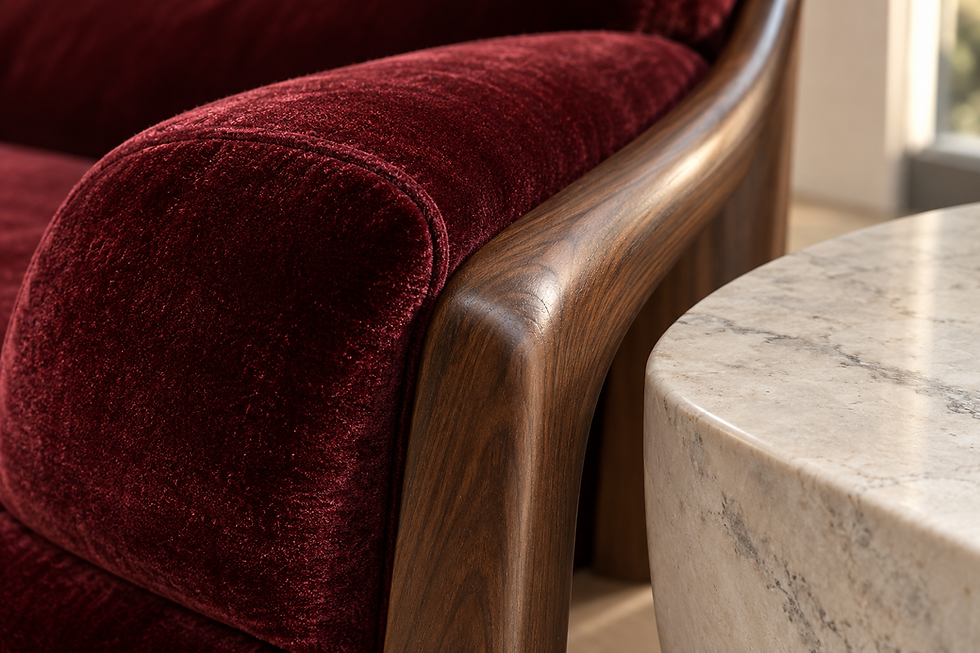
Velvet brings depth to burgundy because its pile interacts with light and handling. Turn a substantial sample, brush it in different directions and observe it next to a smoother textile. The changing appearance may be precisely what makes the fabric appealing, but it should be an accepted characteristic rather than a surprise after delivery. Ask the supplier how the selected product should be oriented across cushions and panels. Differences that seem minor on a swatch can become more noticeable on a long sofa viewed across the room.
For the jade chair, compare tightly woven options with different surface textures and hand. Consider how they feel against bare arms, whether the seams remain visually clean and what the manufacturer requires for care. A fabric described as suitable for frequent use still needs product-specific guidance. Do not infer stain immunity from a marketing label. Request written information on cleaning and any limitations, then weigh that maintenance against the household's habits. The best pairing may be one expressive pile fabric and one calmer weave, allowing the tactile contrast to enrich the room without multiplying decorative patterns.
Select stone that can share attention with the art
In an art-focused room, strong stone veining acts as another image. Decide whether that is welcome before selecting a slab or table. A pale, comparatively quiet surface may provide enough material richness while allowing a painting to remain the main focal point. Examine the actual proposed material and its edge treatment, not just a photograph of another piece with the same trade name. Ask how variation will be approved and whether the tabletop is solid, veneered or assembled over a substrate.
Care expectations should be discussed before the appearance becomes emotionally nonnegotiable. The Natural Stone Institute explains that acids can etch calcareous stones and that impregnating treatments do not make stone stain-proof. Confirm the specific stone and the supplier's instructions, especially for a table used for drinks or meals. If quartzite is considered, distinguish it from manufactured quartz and obtain reliable identification rather than relying on its name or price. Choose a material whose behavior you can live with, or choose a different surface; a beautiful table loses its appeal if ordinary use becomes a persistent source of anxiety.
Material and planning reference: Natural Stone Institute: natural stone care.
Use walnut grain to connect rather than imitate
Walnut can make a richly colored room feel grounded, but matching every timber surface exactly is unnecessary. A broad cabinet might use a calm grain arrangement while a chair shell celebrates a more expressive figure. Compare undertone and sheen across the proposed pieces to establish a family resemblance. Ask the maker to show grain direction on drawings, including how it turns at corners and continues across adjacent fronts. These decisions affect the impression of craftsmanship more than adding another decorative profile.
Wood also needs to be considered as a material that exchanges moisture with surrounding air. Construction, storage and handling matter, and no finish should be presented as making unspecified wood immune to movement. Confirm the maker's intended construction and care advice. Keep approved samples, noting that a small sample cannot predict every natural variation. When an existing piece is retained, compare it with the new finish in the actual room instead of attempting an exact match from memory. Deliberate differences often create a more convincing interior than a near match that repeatedly looks accidental under changing light.

Separate art light from reading and evening light
Begin with activities rather than a dramatic fixture. General illumination supports movement, focused task light serves reading or work, and selected accent light can give an artwork or object attention. These layers should be considered together, as described in Lutron's guidance, even when the final product choices are simple. A painting that looks clear from the entrance may show reflections from the sofa. Evaluate likely viewing positions and ask an appropriate specialist about sensitive artworks rather than assuming brighter always means better.
Imagine three settings: an ordinary evening, a conversation with guests and a quiet hour with a book. The room should support each without requiring every light to be equally strong. Review switches, controls and access from the places where they will be used, with installation questions resolved by the relevant professionals. Lamp cords should have a planned route rather than trailing through circulation. A decorative shade can also tint the perceived upholstery color, so assess the palette under the proposed lighting. Light becomes part of the material selection process, not a finishing accessory added after every surface has been ordered.
Material and planning reference: Lutron: layered lighting tips.
Let drapery manage the edge of the room
Window treatments shape the relationship between daylight, privacy and the room's strongest colors. Before choosing cloth, decide what the window must do at different times: admit light, soften a view, provide privacy or create a quieter visual background. Consider whether layered treatments are needed and how they will operate around furniture. A beautiful fabric is less useful if a chair blocks the control or the curtain stacks over an important artwork. Draw the stack-back and hardware positions as part of the elevation.
Evaluate the drapery sample vertically and against actual light. The same cloth may look denser on a table than it does hanging in front of a window. Inspect the weave, transparency and movement, then check lining and care recommendations for the specific product. Avoid choosing a heavy treatment solely to imply acoustic or thermal performance that has not been established. In this concept, a quieter neutral drapery gives burgundy and jade room to breathe. Its softness helps balance the polished timber and stone while preserving the architecture of the window rather than turning it into another competing centerpiece.
Design the bedroom as a deliberate change of pace
The bedroom can borrow from the living room without reproducing its intensity. A muted wine headboard, pale jade chair and walnut bedside cabinetry retain continuity while reducing contrast. Start with the occupant's sequence of use: entering, changing, reading, putting devices away and getting up. Useful bedside surfaces and reachable controls deserve priority over symmetry if the room or the occupants' habits call for different arrangements. A chair belongs only where it supports a real activity and does not become an obstacle or a permanent pile of clothing.
Give the bed a calmer visual field. One carefully placed artwork may be more effective than a wall filled to match the public rooms. Review bedding and upholstery by touch as well as color, and consider the sound and movement of window treatments during operation. Sensory comfort is personal; do not assume a fragrance is wanted. Ask about preferences and sensitivities, including textures the occupant dislikes. A restful room is created through an accumulation of ordinary decisions that fit its user, rather than through a claim that one palette or product produces the same response in everyone.
Build storage that protects both usefulness and display
A display cabinet should begin with an inventory of what it must hold. Books, framed photographs, ceramics, equipment and everyday papers need different clearances and access. Allocate concealed space for objects that are useful but visually busy, then give selected open areas a clear purpose. If every shelf is designed as a permanent vignette, there may be nowhere to put the materials that actually support life in the room. Include the belongings already in circulation, not only the ones that look good in the proposed illustration.
Review cabinet doors and drawers in their open positions against nearby furniture. Where equipment is enclosed, establish its operating and access requirements with the relevant supplier. Plan cable routes and service access before a cabinet is fabricated. Consider a modest area for changing displays so a new object does not displace the entire arrangement. This supports collecting as an ongoing interest while keeping the home manageable. Storage should help the owner retrieve, use and return things with little friction; its visual restraint is most convincing when it reflects a practical system rather than the temporary removal of ordinary belongings.
Agree on maintenance without designing around fear
Discuss which signs of use feel acceptable and which would be frustrating. Some owners enjoy a material that changes gradually; others want a more consistent appearance and are prepared to select accordingly. Neither preference is more sophisticated. List the surfaces that receive frequent contact, including sofa arms, cabinet handles and table edges, and ask for the actual care instructions. This conversation often reveals where a durable, straightforward choice matters more than a highly expressive finish, leaving other areas available for more delicate or demanding materials.
Create a small care record with product names, approved finishes, supplier contacts and written instructions. Keep spare parts or extra upholstery only where they are practical and available, rather than assuming every product can be repaired indefinitely. Know who will resolve a damaged custom component before the order is signed. A home designed for art still needs to accommodate a spilled drink and an untidy evening. Thoughtful maintenance planning makes those events easier to handle, allowing the owner to enjoy the collection and furnishings instead of treating the entire residence as a set of things that must never be touched.
Spend first on decisions that improve the whole room
Identify the few choices with the greatest effect on daily use. A correct sofa size, a comfortable chair, well-planned window treatments and useful storage can improve many hours of ordinary life. A costly object bought before those relationships are resolved may consume resources without solving the main problem. Separate the design budget into necessary functional work, principal furniture and materials, and optional decorative layers. The categories make tradeoffs visible and help the owner postpone an accessory without compromising the underlying plan.
For an art-led Wynwood home, reserve flexibility for the collection itself. Avoid committing every wall, tabletop and purchasing allowance to a finished decorative package. If work is phased, record the intended final arrangement so an early purchase does not obstruct later cabinetry or curtain installation. Confirm what each proposal includes, what remains an owner decision and which items require separate specialists or approvals. Endless Life Design can help define the space-planning and 3D design work, product sourcing and procurement planning to be included in the agreed scope. Clear responsibilities make the investment easier to evaluate and the next decision easier to take.
Check the plan before any custom order is released
Review the plan while imagining a friend arriving, someone carrying a drink and another person opening a cabinet. Compare furniture footprints, door swings, curtain operation and art placement in the same drawing. Check that every frequently used seat has the support, light and nearby surface it needs. Verify dimensions against the property and delivery route, then confirm the approved fabric, grain arrangement, finish and stone selection. These decisions should be written into the order rather than left as assumptions based on the most attractive rendering.
Request an understandable record of substitutions and approvals. If a specified fabric becomes unavailable, a similar color does not automatically mean similar weave, hand or care. If the table changes size, check the seating group again. Keep unresolved questions visible until somebody is responsible for answering them. This is also the moment to ask whether the room still feels personal after its practical requirements have been solved. The objective is a home where the collection, furniture and everyday routines reinforce one another, with enough clarity in the documentation to carry that intention through purchasing and installation.
Questions to bring to a Wynwood design consultation
Can the room be colorful if the art is already strong? Yes, provided the combined composition is tested rather than judged as separate purchases. Bring images of the works and physical material samples together. Must every furnishing be custom? No; customization is most useful when it resolves a specific fit, use or material requirement. A well-chosen standard piece can be an excellent part of the same scheme. Can an existing sofa remain? Start by assessing its comfort, condition and dimensions before assuming replacement is necessary.
For a productive first conversation, gather available plans, photographs taken from several corners, a list of retained objects and a short account of what currently feels difficult. Identify the rooms in scope and the decisions you want help making. Include maintenance preferences and the atmosphere you want when the room is occupied, not just when it is tidy. Contact Endless Life Design to discuss a residential interior design proposal for your Wynwood home. A clear brief gives the project a strong beginning: personal expression supported by comfortable furniture, coherent materials and a layout that remains useful after the first impression.
Residential interior design services near me, in Miami, Florida: hiring questions
Use this Wynwood brief when discussing custom residential interior design services in Miami, Florida with Endless Life Design.
An art-focused home needs places for ordinary life as well as display. Describe the works you own, how often the arrangement changes and where you want a quieter visual atmosphere before selecting furniture or decorative finishes.
How do I choose the best residential interior designer near me in Miami, FL?
If your search began with “hire best custom residential interior designer near me in Miami, FL,” ask how the designer will make the collection livable. A persuasive plan should identify viewing positions, comfortable seating and practical circulation while leaving enough visual space around significant works.
How should I compare top residential interior designers near me?
Compare the same art inventory, room dimensions and storage needs. Ask candidates to explain furniture scale and lighting intent, including where specialist advice may be useful for sensitive or unusually installed pieces.
What should residential interior design services near me in Miami, FL include?
If you requested “custom residential interior design services near me in Miami, Florida,” confirm whether art-layout drawings, display storage, furniture specifications and lighting coordination are included. Establish who verifies dimensions and who approves changes when a selected piece or artwork moves.
What should I ask a luxury residential interior designer near me in Miami, FL?
Ask to compare the proposed upholstery texture with the artwork's color and surface character. A sculptural chair can support the room without competing with every wall; comfort and usable table positions still matter.
How is custom residential interior design near me in Miami, FL developed?
Begin with the collection's strongest visual relationships, then develop the supporting furniture. Test a restrained material set and leave room for the eye to rest between dramatic colors, patterns and silhouettes.
What should high-end interior design services near me in Miami, FL deliver?
Expect an approved placement plan, installation notes and a furniture schedule. Document which positions are flexible and which depend on coordinated lighting or support so future rearrangements remain intentional.
Plan your Wynwood interior with Endless Life Design
Bring your floor plan, room photographs and priorities to a conversation about residential interior design and 3D planning. Confirm the rooms, deliverables, procurement responsibilities and fee in your written proposal before work begins.
Call (305) 680-3283 or contact Endless Life Design to discuss the next step for your home.


Comments