

Brewery and Distillery Permits in Miami-Dade, Broward, and Palm Beach: TTB Federal Licensing, Florida ABT, Production Engineering, Brewpub Food Service, and Distillery Bonded Areas

Updated: Aug 12
Craft brewery, distillery, and brewpub construction in Miami-Dade, Broward, and Palm Beach County combines two of the most regulatory-intensive industries — beverage production with federal and state alcohol licensing layers — with construction work that involves mechanical, electrical, plumbing, and life-safety engineering for the production equipment, the tasting room, and the food service operations these establishments frequently include. A brewery project moves through coordinated approval from the federal Alcohol and Tobacco Tax and Trade Bureau (TTB) for the federal brewer's notice or distilled spirits plant license, the Florida Department of Business and Professional Regulation Division of Alcoholic Beverages and Tobacco (ABT) for state alcohol licensing, the host municipality for the construction build-out permits and Certificate of Use, the Florida Department of Health for any food service operations, FDEP for any wastewater discharge from brewing operations affecting municipal sewer infrastructure, and frequently host-city economic development incentives that breweries and distilleries qualify for in cities cultivating craft beverage industries. Endless Life Design exists so you don't have to navigate this. We are a licensed Florida general contractor and custom construction company that operates inside every South Florida brewery and distillery permit workflow daily — coordinating federal and state alcohol licensing alongside construction permits, sealed mechanical and electrical engineering for production equipment, food service permits for tasting rooms and brewpubs, and delivering operational breweries and distilleries from concept to opening day. Call (305) 680-3283 or visit our Government Permit Processing Service page to start.
Index
1. TTB Federal Brewer's Notice and Distilled Spirits Plant Licensing We Coordinate
2. Florida ABT State Alcohol License Classes We Process for Each Concept
3. Brewery Production Equipment Mechanical and Electrical Engineering
4. Plumbing, Wastewater, and FDEP Discharge Permits for Brewing Operations
5. Tasting Room, Taproom, and Brewpub Food Service Integration
6. Distillery Specifics — Bonded Areas, Fire-Protection, and Spirit Storage
7. Zoning Permissibility and Host City Cultivation Initiatives
8. Certificate of Use, Business Tax Receipt, and Inspection Coordination
9. Why the Permit Process Earns Respect — One Planet, Interconnected Systems
10. Where to Start: Why Brewery and Distillery Owners Hire Endless Life Design — Plus Every Concept We Serve
1. TTB Federal Brewer's Notice and Distilled Spirits Plant Licensing We Coordinate
Every brewery in the United States operates under a federal Brewer's Notice issued by the Alcohol and Tobacco Tax and Trade Bureau (TTB), a bureau of the U.S. Department of the Treasury. Every distillery operates under a Distilled Spirits Plant (DSP) permit also issued by TTB. The federal licensing is foundational — without it, the brewery or distillery cannot legally produce alcoholic beverages regardless of state and local approvals. The federal application is substantial: a Brewer's Notice application typically runs 30-60 pages plus supporting documentation including the brewery's premises diagram showing the production area, fermentation area, packaging area, storage area, and any tasting room with clear delineation of the bonded area where untaxed beer is produced and stored; the brewery's organizational documents documenting ownership, financial responsibility, and applicant background; the security plan documenting how the brewery prevents unauthorized access to the bonded area; and the operations plan documenting production methods, recipes (at the federal level by general category), and production volumes.
We coordinate TTB federal applications in parallel with the host municipality construction permits and the state ABT licensing. TTB processing currently runs 90-180 days for Brewer's Notice applications and somewhat longer for Distilled Spirits Plant applications given the additional security requirements applicable to distilled spirits operations. Starting the TTB application early in the project timeline is essential — breweries that complete construction before federal approval cannot legally begin production, sometimes facing weeks or months of operational delay even after the physical brewery is ready. Our integrated workflow starts the TTB application at the same time as the host municipality building permit application, with the federal review running concurrently with construction so that federal approval aligns with construction completion and the brewery can begin operations immediately after final building inspection.
2. Florida ABT State Alcohol License Classes We Process for Each Concept
Florida's Division of Alcoholic Beverages and Tobacco (ABT) under the Department of Business and Professional Regulation issues state alcohol licenses across multiple classes depending on the brewery's specific operations. The CMBP (Craft Manufacturer's Beer Permit) authorizes a craft brewery to manufacture beer and to sell beer for on-premise consumption in a tap room or for retail off-premise sales. The 1COP (Consumption On Premise) license adds full bar service for on-premise consumption of beer, wine, and spirits at the brewery's taproom. The 4COP (Consumption On Premise plus Liquor) license adds spirits service for distilleries operating tasting rooms. Distilleries operate under DSP-aligned state distillery licensing with specific provisions for craft distilleries that allow direct-to-consumer sales of distilled spirits. Brewpubs combining brewing with full-service restaurant operations operate under specific brewpub licensing combining production with restaurant licensing.
We coordinate Florida ABT state licensing in parallel with the federal TTB licensing and the host municipality construction permits. The state application requires the federal TTB approval (typically the federal approval is required before the state issues its final license), the local zoning compliance documentation, the property owner's authorization letter, the applicant's background check documentation, and other supporting documents. State processing typically runs 60-120 days after the federal approval is received, with the timing creating pressure on coordinated project planning. Our experience with ABT staff and the typical processing patterns means efficient state licensing alongside the federal and local approvals — delivering breweries and distilleries with complete regulatory documentation ready for operations on opening day.
3. Brewery Production Equipment Mechanical and Electrical Engineering
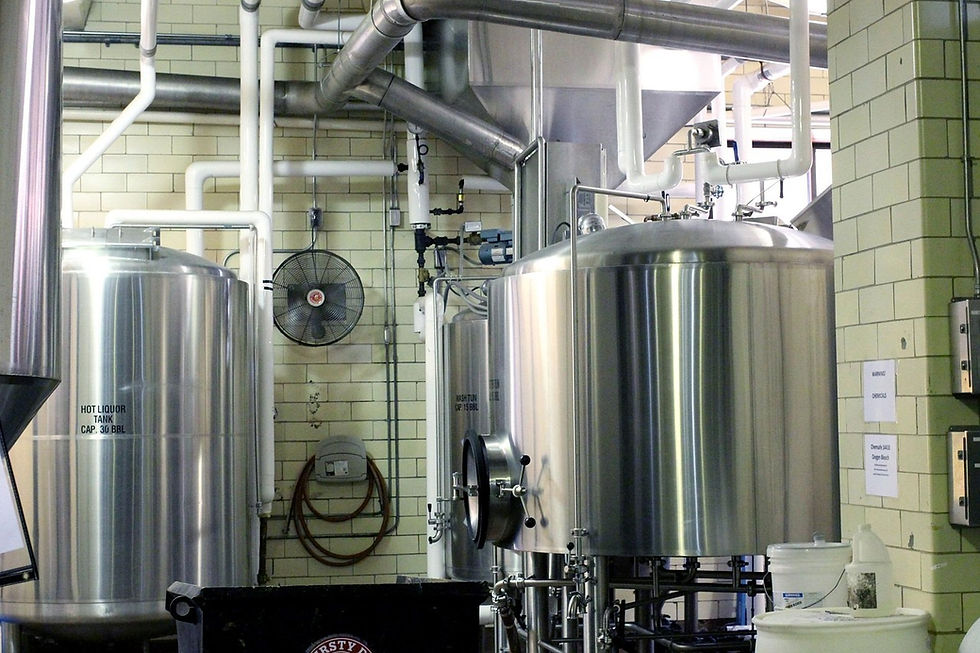
Brewery production equipment requires mechanical and electrical engineering coordinated with the construction work. The brewhouse — typically a 5-30 barrel system depending on the brewery's scale — includes the mash tun, lauter tun, kettle, whirlpool, and heat exchanger arranged for the brewer's specific process. Each vessel requires structural support sized for the filled weight (a 15-barrel kettle weighs several thousand pounds when full), mechanical piping including hot wort transfer lines, glycol cooling lines from the brewery's chiller plant, steam supply if the brewhouse is steam-heated (typically a boiler installation), and electrical service to the heating elements if direct-fired electric. The fermentation cellar typically houses multiple fermenters (unitanks or bright tanks) requiring glycol-cooled wraps for fermentation temperature control, structural floor design supporting the loaded fermenter weight, and floor drains positioned for the cleaning operations that brewers perform constantly.
We engage Florida-licensed mechanical and electrical engineers experienced with brewery and distillery production equipment for every project. The engineering coordinates with the equipment supplier's specifications, the brewer's specific process requirements, the host municipality's code requirements, and the food service requirements (since brewery production is technically food service under Florida law). The electrical engineering sizes the loads — typical 15-barrel brewhouses draw 200-400 amps at three-phase 208V depending on heating type, with glycol chillers, packaging equipment, refrigeration, and ancillary equipment adding substantially more. Service equipment evaluation frequently identifies that the existing electrical service for the chosen building cannot support the brewery loads, requiring service upgrades coordinated with FPL. The mechanical engineering coordinates HVAC for the production area (typically requiring dehumidification given the water vapor that brewing operations produce), the boiler installation if steam-heated, the glycol chiller plant and its distribution, and the process ventilation removing CO2 from fermentation areas.
4. Plumbing, Wastewater, and FDEP Discharge Permits for Brewing Operations
Brewery wastewater is one of the most regulated discharge streams in food service because brewing produces high-strength wastewater — high biological oxygen demand (BOD) from spent grain and yeast, high suspended solids, and the chemical demand from cleaning chemicals. The host municipality wastewater treatment system has prescribed limits on each parameter, with breweries above prescribed production thresholds requiring pretreatment systems reducing the discharge strength to within the allowable limits. Common pretreatment includes screening removing spent grain and yeast solids, pH adjustment buffering the acidic cleaning waste, and grease/oil separation though minimal grease is generated by brewing alone (brewpubs combining brewing with food service face the standard restaurant grease trap requirements on top of the brewing pretreatment). For broader environmental permitting context, see our environmental permitting guide.
We coordinate brewery wastewater pretreatment design and permitting for every brewery project. The work involves evaluating the projected wastewater volumes and strength based on the brewery's planned production, designing the appropriate pretreatment system sized to the brewery's scale (often a cost component for breweries above 5,000-10,000 barrels annual production), coordinating with the host municipality wastewater authority for any required pretreatment permit and ongoing monitoring requirements, and integrating the pretreatment into the brewery's overall plumbing and process design. Discharge above prescribed thresholds requires FDEP industrial wastewater discharge permits with ongoing monitoring obligations. Most craft breweries at the typical South Florida scale stay below the FDEP threshold but face the host municipality pretreatment requirements. Spent grain — the solid waste byproduct of brewing — is typically removed from the brewery for sale or donation to farms as animal feed, with the removal coordination part of the brewery's operational planning.
5. Tasting Room, Taproom, and Brewpub Food Service Integration
Most breweries operate tasting rooms or taprooms serving the brewery's beer to customers for on-premise consumption, with many adding food service through full kitchens (brewpubs), limited kitchens (taproom food), food trucks operating from the brewery's parking, or food partnerships with neighboring restaurants. Each food service approach triggers different code requirements. Brewpub kitchens face full restaurant occupancy code including kitchen exhaust hood permits, grease trap installations, plumbing for food service equipment, electrical for commercial cooking equipment, Department of Health licensing as full-service restaurants, and the Florida DBPR Division of Hotels and Restaurants licensing applicable to restaurant occupancies. Taproom limited food (typically warming and serving of prepared items rather than full cooking) faces reduced code requirements but still requires Department of Health food service licensing. Food truck operations require separate food truck licensing with their own regulatory framework. For broader restaurant permit coverage, see our restaurant building permits guide.
We coordinate tasting room, taproom, and brewpub food service integration as part of the integrated brewery construction. The tasting room build-out includes the bar with appropriate plumbing and electrical for draft beer dispensing (typically 12-24 taps with glycol-chilled lines running from the cooler to each tap), seating areas designed for assembly occupancy with appropriate accessibility provisions, restrooms sized to the assembly occupancy load, and the life-safety and accessibility provisions applicable to assembly occupancies. The brewpub kitchen integrates with the brewery's overall plumbing, electrical, and mechanical systems while satisfying restaurant code requirements. The food truck parking area requires the host municipality permitting if the trucks operate as regular fixtures rather than occasional visitors. Our integrated workflow delivers brewery+taproom+kitchen as a single project rather than fragmented separate workflows.
6. Distillery Specifics — Bonded Areas, Fire-Protection, and Spirit Storage
Distilleries face substantially more stringent requirements than breweries due to the higher fire hazard from distilled spirits. The bonded area where untaxed spirits are produced and stored requires specific physical security — typically a secure room or enclosure with restricted access, alarm systems, and inventory controls satisfying TTB requirements. Spirit storage faces NFPA 30 Flammable and Combustible Liquids Code requirements including specific separation distances from ignition sources, ventilation removing potentially flammable vapors, electrical equipment in storage areas rated for the hazardous environment (Class I Division 2 typically), fire-protection systems including specialty sprinklers and fire suppression sized for the fire load that bulk spirits represent, and explosion-relief design for high-volume distilleries. The host fire department reviews distillery installations with the depth of scrutiny that the fire hazard requires.
We coordinate distillery-specific construction across South Florida. Our work includes the bonded area design satisfying TTB requirements while integrating with the broader facility's workflow, the fire-protection engineering specifying the appropriate sprinkler and suppression systems, the electrical engineering specifying hazardous-location-rated equipment in spirit storage areas and the proper separation from non-hazardous electrical zones in production and retail areas, the mechanical engineering specifying the ventilation removing flammable vapors, and the integration with the host fire department through pre-design consultation and construction-phase coordination. Craft distilleries operating tasting rooms add the assembly occupancy considerations from breweries plus the specific spirits-service licensing from ABT. Distilleries combining production with cocktail bars (where craft distilleries can serve cocktails featuring their spirits) face an additional layer combining production with full bar operations.
7. Zoning Permissibility and Host City Cultivation Initiatives
Brewery and distillery zoning permissibility varies substantially across South Florida municipalities. Most cities classify brewery and distillery production as industrial uses requiring industrial-zoned property — making many appealing storefront locations unavailable without zoning amendments or special exceptions. Cities cultivating craft beverage industries (including parts of the City of Miami including Wynwood and Little Havana areas, the Fort Lauderdale FATVillage and Flagler Village areas, the Delray Beach Pineapple Grove area, and select areas in West Palm Beach) have created specific zoning provisions allowing brewery and distillery operations in commercial-zoned property under prescribed conditions including production size limits, distance from sensitive uses, hours of operation restrictions, and other modifications. For broader zoning context, see our zoning permits, special exceptions, and variances guide.
We research zoning permissibility for every prospective brewery and distillery location at the pre-lease stage when possible. The analysis identifies the specific zoning designation of the property, the use permissibility for brewery or distillery operations, any host city craft beverage cultivation provisions applicable to the property's area, the dimensional requirements (production size limits, setbacks from residential zones, distance from schools and religious facilities, hours of operation restrictions), and any required special exception or zoning amendment processes. Prospective brewery owners benefit from this analysis substantially because the zoning constraints frequently determine whether a property is feasible at all — leases signed before zoning analysis frequently result in property owners unable to actually operate the brewery they planned. Some cities offer economic development incentives for craft beverage operations including expedited permitting, fee waivers, or grant programs that we identify and help applicants pursue.
8. Certificate of Use, Business Tax Receipt, and Inspection Coordination
Every brewery and distillery in South Florida requires a Certificate of Use from the host municipality documenting the brewery's permitted operation at the specific address, the appropriate occupancy classifications (industrial for production, assembly for tasting room, restaurant for brewpub kitchen), the satisfaction of all applicable code requirements, and the completion of all required specialty approvals. Beyond the Certificate of Use, the brewery requires a Business Tax Receipt from the host municipality's Finance Department, the federal TTB Brewer's Notice or DSP, the Florida ABT state alcohol license, Florida Department of Health food service licensing where applicable, FDEP coordination for wastewater discharge where applicable, and ongoing operational permits and reports. For broader certificate coverage, see our Certificate of Occupancy vs Certificate of Use guide.
We coordinate Certificate of Use, Business Tax Receipt, federal TTB, state ABT, and all required ancillary approvals for every brewery and distillery client. The CU coordination integrates with the construction work through inspection scheduling at completion of each construction phase, with the final CU inspection scheduled at construction completion. The federal and state alcohol licensing runs in parallel with the construction so that federal and state approvals align with construction completion. The Business Tax Receipt processes immediately after CU issuance. The Florida Department of Health food service licensing for brewpub and taproom food operations processes through the standard restaurant inspection workflow. The result is breweries and distilleries with every regulatory layer in place on opening day — without the operational delays that frequently affect breweries that coordinate approvals less carefully.
9. Why the Permit Process Earns Respect — One Planet, Interconnected Systems
Brewery and distillery operations illustrate the multi-layer interconnectedness of construction with unusual clarity because alcoholic beverage production touches federal, state, county, and municipal regulatory frameworks plus the broader environmental and community systems around the operation. The TTB federal Brewer's Notice ties the brewery to the federal alcohol tax collection system serving the entire United States Treasury. The Florida ABT state license ties the brewery to the state alcohol regulatory system. The host municipality construction permits and Certificate of Use tie the brewery to the local infrastructure. The FDEP wastewater discharge permit ties the brewery's process waste to the regional water management system protecting the Atlantic Ocean and the Everglades. The Department of Health food service permit for tasting rooms protects public health for everyone who consumes food at the operation. The fire department review for distilleries protects the surrounding community from the fire hazard that bulk spirits storage represents. The zoning permissibility coordination protects neighbors from incompatible industrial operations adjacent to residential or sensitive uses. None of brewery or distillery construction is private — every aspect connects to broader systems requiring coordination.
The permit process is the coordination. Every project moves through engineer-to-engineer review — the engineering prepared by the property owner's licensed Florida engineers is reviewed by the host municipality's own licensed engineers, both operating under Florida Statutes Chapter 471 and identical professional standards. The federal TTB review is engineer-to-engineer at the federal level. The state ABT review applies the state's regulatory framework. The plan review is not a bureaucratic obstacle; it is a credentialed peer verifying the design before construction begins. The inspections at each construction milestone are not nitpicking; they are the system verifying that the work matches the approved plans. The document stack — TTB application package, state ABT application, mechanical and electrical engineering, wastewater pretreatment design, fire-protection engineering, food service compliance, zoning verification — exists because each document protects a specific aspect of the project. The fees fund the regulators who actually do this work. The time it takes is the time those professionals need to do the work properly. For the complete philosophical and process explanation of why this matters, see our pillar guide on how the construction permit process actually works in South Florida.
10. Where to Start: Why Brewery and Distillery Owners Hire Endless Life Design — Plus Every Concept We Serve
Brewery and distillery owners hire Endless Life Design when they realize that these projects are not just construction — they are multi-agency regulatory coordination projects involving the TTB at the federal level, the Florida ABT at the state level, the host municipality at the local level, FDEP at the environmental level, the Department of Health for food service operations, the host fire department for fire-protection coordination, the zoning division for use permissibility, and the integrated construction execution that brings the production equipment, the tasting room, and the food service operations together. We coordinate all of it across South Florida. When you hire us, you stop trying to figure out which agency needs which document, you stop wondering whether your federal application will align with construction completion, you stop worrying whether your wastewater design will satisfy host municipality pretreatment requirements — we handle every interaction, deliver every approval, and produce operational breweries and distilleries on opening day. Call (305) 680-3283 to schedule a brewery or distillery consultation.
We provide end-to-end brewery, distillery, brewpub, taproom permit, federal and state alcohol licensing coordination, sealed mechanical and electrical engineering, construction, and integrated build-out service for every craft beverage concept across Miami-Dade, Broward, and Palm Beach County: production breweries serving wholesale and retail markets, brewpubs combining brewing with full-service restaurants, taproom-only breweries serving on-premise consumption with limited or partner-provided food service, contract breweries producing beer for multiple labels, mead and cider operations under similar regulatory frameworks, craft distilleries producing whiskey, bourbon, rye, vodka, gin, rum, brandy, agave spirits, and specialty distilled products, distillery tasting rooms operating under craft distillery provisions allowing direct-to-consumer cocktails, restaurants with full bar service requiring 4COP licensing, hotels and resorts with bar and lounge operations, event venues and banquet halls requiring alcohol service, retail operations requiring beer and wine sales licensing, and the integrated construction work for every business type alongside the alcohol licensing — restaurants, cafés, bakeries, juice bars, coffee shops, ice cream parlors, food halls, ghost kitchens, catering kitchens, hair salons, barbershops, nail salons, eyelash and waxing studios, day spas, tattoo studios, gyms, pilates studios, yoga studios, CrossFit boxes, boxing and MMA gyms, dance studios, personal training studios, retail boutiques, jewelry stores, furniture showrooms, electronics stores, bookstores, pet supply stores, sporting goods, bridal shops, art galleries, vape and smoke shops, medical and dental practices, dermatology and plastic surgery clinics, urgent care, veterinary hospitals, pharmacies, physical therapy and chiropractic offices, mental health practices, optometrists, law firms, accounting firms, insurance agencies, real estate offices, mortgage brokers, financial advisors, marketing agencies, architecture and engineering firms, photography studios, dry cleaners, laundromats, self-storage facilities, moving offices, print shops, sign shops, funeral homes, co-working spaces, hotels, boutique inns, resorts, event venues, banquet halls, wedding venues, movie theaters, arcades, bowling alleys, escape rooms, trampoline parks, indoor playgrounds, private K-12 schools, daycares, preschools, Montessori schools, tutoring centers, music and art schools, language schools, driving schools, trade schools, auto dealerships, repair shops, body shops, car washes, tire shops, marine dealers, RV dealers, warehouses, distribution centers, light manufacturing, workshops, office buildings, churches, synagogues, mosques, temples, community centers, non-profits, property management companies, residential developers, homebuilders, apartment complexes, condominium associations, and HOA-managed buildings. Visit endlesslifedesign.com, browse our Commercial Projects gallery, or call (305) 680-3283 today.
Related Permit Resources
Continue exploring: Storm Damage Repair and Insurance Claim Coordination in Miami-Dade, Broward, and Palm Beach: Hurricane Damage, Florida Claim Window, FEMA Improvement, and Hardening Upgrades • Generator Permits in Miami-Dade, Broward, and Palm Beach: Whole-Home Standby, Commercial Backup, AHCA Florida Generator Rule, and Hurricane-Season Installation • Solar PV and EV Charger Permits in Miami-Dade, Broward, and Palm Beach: Engineering, FPL Interconnection, Battery Storage, and Commercial Charging Stations • How the Construction Permit Process Actually Works in South Florida: One Planet, Engineer-to-Engineer Review, the Document Stack, and Respect for the Professionals • Ready to secure your approvals? Explore our Government Permit Processing Service or call (305) 680-3283 today.
We are also a full-service interior design company and interior decoration company — offering interior design services, room design and home styling, with living room decor ideas, bedroom decor ideas, kitchen decorating and bathroom decor ideas for houses, condos and estates across Miami-Dade, Broward and Palm Beach.
People also find us searching: home decorator, home decorate, interiors, room decorating, inside design, interior design firms, interior company, shop interior design, interior design stores, interior design shop, interior design publications, ideas for wall decor, design interior design, interior design interior design, interior and design, d interior design, house designer near me, interior designer near by me, interior designers in near me, interior designs styles, interior design and styling, interior design styling, interior decoration store, design room design, home interior design, interior design near me, living room design, interior design companies near me, interior designer near me, interior decorator near me, house designers near me, living room decor ideas, bedroom decor ideas, home decor ideas, interior design services, house decor ideas, sitting room decor ideas, home interior ideas, living decor ideas, interior ideas for living room, bedroom interior ideas, bedroom decoration design, bathroom decor ideas, bedroom decoration, bed room decoration, small living room decorating ideas, small living room furniture ideas, room designer, room decor ideas, interior design company, interior company, interior decoration company, kitchen decorating, wall decor for living room, living room decor, kitchen decor ideas, home styling, master bathroom decor ideas, decorating a small bedroom, modern bathroom decor ideas, shop home decor, stores for home decor, and interior designers.
Comments